Archive for the ‘Real Estate Statistics’ Category

Good Time or Bad Time To Buy a Home?

Friday, January 6th, 2012

Most people considering the purchase of a home, whether in Spruce Grove, Stony Plain, Parkland County, the Edmonton region, or elsewhere, get around to asking the important question:  “Is now a good time or a bad time to buy a home?”  It sounds flippant or evasive if I respond with “Yes” or “That depends”, but both answers are correct!  For most people, buying a home is one of the most significant events in their lives, and it naturally comes with many positives and negatives based on individual situations.  Once people have made the decision to invest in a home, the best time to buy becomes “now”, no matter what the market is doing.

But the market at the moment in the Edmonton area is making the decision to buy much easier.  An article in the January 5, 2012 Edmonton Journal entitled “Real estate market healthy, agents say” contains some very encouraging news.   In spite of crises elsewhere (Europe’s money woes, the US housing market), prices and sales in our region remain steady.  The article quotes a statistic from the Realtors Association of Edmonton:  the average price of homes sold through MLS in 2011 was $325,457.  This is down slightly from $329,019 in 2010, but prices are not undergoing the wild swings we’ve experienced in the past or the ups and downs felt elsewhere.  The article also points out that 827 properties were sold in December 2011, compared to just two more the previous December. 

Is right now, just after New Year’s, a good time to buy?  Sure, why not?  The article mentions that the market usually picks up in the summer, with April and May being peak months, but there is always an inventory of homes waiting for the right buyer, and the current market stability, combined with continuing low mortgage rates, all suggest the time is never better!  

I’d love to help you find that perfect home!  Call me at 780-910-9669, email me at btwynam@telusplanet.net, or contact me here.

Recent Canadian Home Prices

Tuesday, December 7th, 2010

Most of us wonder from time to time what our home in Spruce Grove, Stony Plain, Parkland County or the Edmonton area is worth in today’s real estate market, and we may also wonder what prices are like elsewhere in Canada.

From the Canadian Real Estate Association: 

“Each month, The Canadian Real Estate Association compiles the statistics of existing homes and properties sold through the Multiple Listing Service®. This provides an overview of the existing housing market in Canada, and tracks market trends for prices and properties sold.”

Here are CREA’s latest home price comparisons: 

  October 2010 October 2009
British Columbia $521,871 $493,328
Alberta $344,569 $351,768
Saskatchewan $234,147 $230,958
Manitoba $224,439 $204,606
Ontario $347,788 $337,410
Quebec $257,456 $239,240
New Brunswick $152,087 $151,218
Nova Scotia $194,578 $189,570
Prince Edward Island $150,091 $155,028
Newfoundland/Labrador $231,039 $196,847
Yukon $304,800 $296,738
Northwest Territories $352,869 $363,435
National Average $343,747 $341,232


Can we draw any conclusions from this data?

We probably knew already that the highest home prices are to be found in BC, but we can see a few other things:

  • In October 2010, only 4 provinces/territories had prices above the national average:  BC, NWT, Ontario and Alberta, in that order.
  • The average selling price in October 2010 for a home in BC was roughly 3 ½ times that of a home in the area having the lowest average price in Canada, PEI.
  • Average prices were higher in October 2010 than the previous year in every area of Canada except Alberta, PEI and NWT.

The interactive map on this page of the CREA website also allows us to compare average selling prices for a few of the major cities in Canada.  For Edmonton and Calgary this is what we find: 

  October 2010 October 2009  
Edmonton $317,096 $351,768 -$34,672
Calgary $399,679 $393,574 +$ 6,105


Now why, we might ask, did Edmonton prices drop close to 10% during the one-year period between October 2009 and October 2010 while Calgary’s increased more than 1.5%?  The data provided by the Canadian Real Estate Association provide only the bare facts.  Chances are, we’d discover many complex reasons for this disparity:  things like types of property sold (single family homes vs. multi-family dwellings, condos, etc.), the number of homes on the market, along with features of the properties, such as age, size, condition, location, amenities, and many more.  Average home selling prices also don’t tell us about historical price gaps between Calgary and Edmonton, with Calgary prices usually being $50,000 to $60,000 higher than Edmonton.  In the end, determining a home’s value is a complicated business!

Interested in a free home evaluation?  Give me a call today at 780-910-9669 or email me at btwynam@telusplanet.net.

Is Real Estate a Good Investment?

Monday, July 19th, 2010

realestateadphotos-310Whether in Spruce Grove, Stony Plain, Parkland County, the Edmonton area or elsewhere, REALTORS® love statistics.  We like to know how many and what kind of properties are being listed and sold, and for how much.  We also like to examine trends over time because this helps us help our clients determine realistic property values when they buy or sell a home. 
We often hear about the ups and downs of the real estate market, but what does this really mean?  Is real estate a good investment?  Does real estate always appreciate? 

Answers to these questions can be seen fairly easily by looking at a few statistics, especially when these are presented in graphic format. 

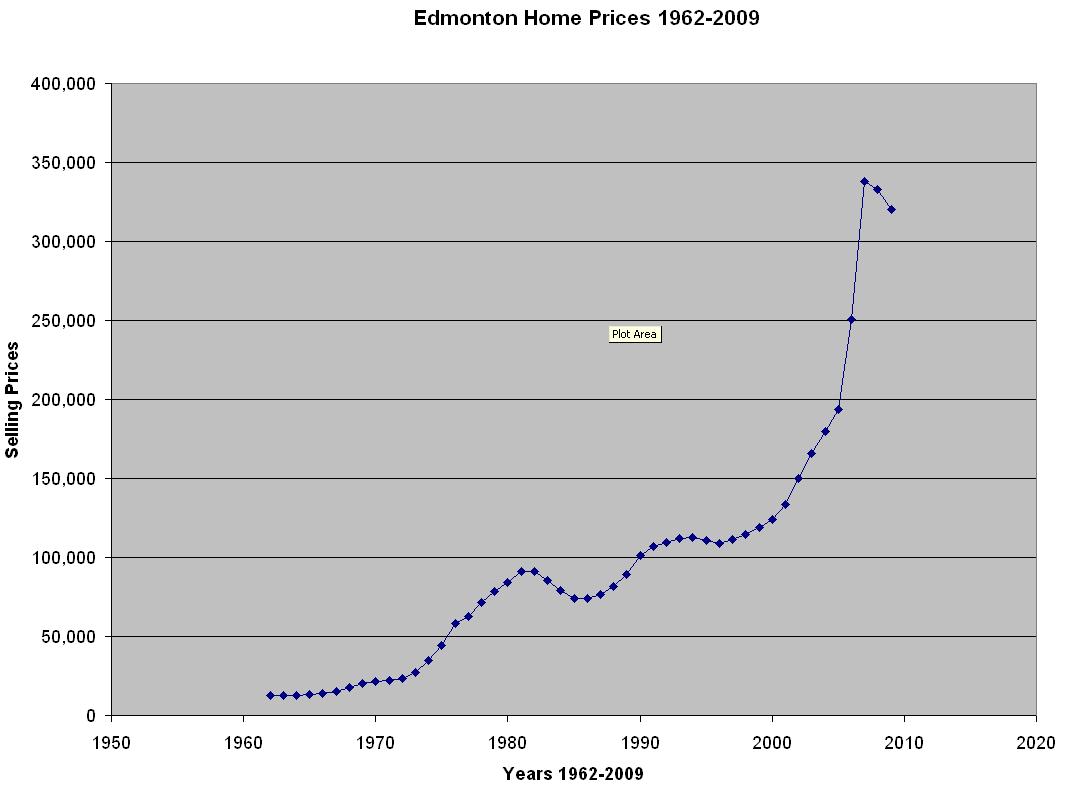
If we look at page 9 of this document from the REALTORS® Association of Edmonton, we see average residential selling prices for homes in the Edmonton area from 1962 to 2009.  If you’re like me, all those numbers make my eyes water!  But let’s look closely at the year-end statistics from 1962 to 2009.  Some interesting trends emerge, and curiously, these trends appear to repeat themselves.  

 From 1962 to 2009 the average selling price of a residence in Edmonton increased from $12,556 to $320,392 – an increase over 47 years of 24 times the starting value!  Does this mean that the value of one’s home doubles every few years?!  Well, sort of…  Examining the numbers year by year, we see that while the overall price trend has been ever higher, the movement is not always steady and not always upward.  There were a number of times during those 47 years when the average selling price in one year, or even for a series of years, was lower than the previous year. 

Prices stumbled in 1964, recovering the next year.  Steady, and in some cases significant growth, continued until 1981.  Looking more closely at the gains during those 16 years, and doing a little math, we discover that double digit percentage gains over the previous year occurred in 1967 (12.3%), 1968 (12.9%) and 1969 (17.7%).  During the next 3 years prices continued to increase but at a more modest rate.  1973 saw prices take another leap (14.6%), and that was followed by 3 more years of huge year over year gains (1974 – 28.2%; 1975 – 26.4%; 1976 – 32%).  A house that sold in 1972 for $24,777 was suddenly “worth” $59,450 only 4 years later.  By 1981 the average selling price had risen to $91,438, a gain of 369% in just 9 years.  Many people buying and then re-selling property during this time made substantial financial gains. 

But the sometimes cruel nature of the real estate market took over in 1981.  A person buying a home in 1981 would have seen prices drop for the next 4 years, and then increase modestly for another 4 years but still not rebound to the price paid in 1981.  A hard lesson perhaps. 

By 1990 the average residence sold in Edmonton for $101,014.  Prices rose for 5 years, fell in 1995 and 1996, and then rose for the next 11 years, up to 2007.  This is eerily reminiscent of the trend mentioned above starting in 1964.  Several of the 11 years between 1997 and 2007 saw a price gain that was dramatic.  In 2002 and 2003 percentage increases were 12.6% and 10.2% respectively.  In 2006 prices rose 29.4%.  This was followed in 2007 by the largest one-year percentage increase since these statistics began:  34.7%, or a rise to a dollar value of $338,009.  Most people are probably aware of what happened to the housing market in the US during this period of time and its effect on house prices throughout North America.  The average selling price of a home in Edmonton dropped 1.5% in 2008 and 3.7% in 2009 but appears to be trending upward so far in 2010.

 These trends are even easier to spot in a chart like this one:

 edtnhomeprices-graph4

  Looking at the proverbial big picture, we see the following:

  • The average annual price increase is roughly 7.8%
  • The average 5-year price increase is about 49%
  • Only 9 years between 1962 and 2009 showed price decreases
  • If you held a property for 9 years, you would always see an increase
  • Edmonton values appear to double every 9 years, on average, since 1962 

Statistics and facts suggest that yes, real estate is definitely a good investment, and yes, it does appreciate over time.  

What about right now in the marketplace?  Are we once again in the trend of a couple years of soft prices followed by a decade of increases?  Are prices going to continue to fall before they recover as they did in the 1980s and 1990s?  Is now a good or bad time to buy and sell?  Hard to predict and impossible to know.  This is, of course, exactly what makes real estate interesting! 

Interested in learning more about the real estate market in Spruce Grove, Stony Plain, Parkland County or the Edmonton area?   Contact Barry today!

Barry Twynam, Realty Executives Leading
#1 14 McLeod Avenue, Spruce Grove, Alberta, T7X 3X3
Tel: 780-962-9696 Cell: 780-910-9669 Fax: 780-962-9699
© Copyright 2011, Real Estate Websites by Redman Technologies Inc. | Privacy Policy | Sitemap
The data included on this website is deemed to be reliable, but is not guaranteed to be accurate by the REALTORS® Association of Edmonton
MLS® MLS REALTOR® Realtor
Trademarks used under license from CREA